Wreckage Cleanup: Masts Cleared From WWII Munitions Hulk
Specialist teams have taken down the towering spires attached to a World War II era shipwreck loaded with high explosives, while the dangerous cargo itself remains undisturbed on the seabed.
By Chioma Kim ·
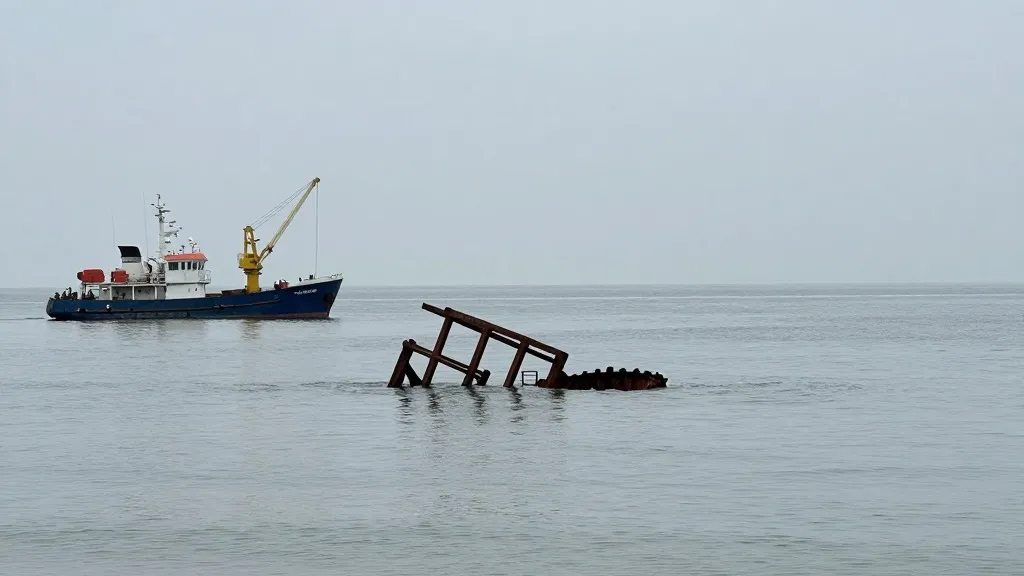
Crews have finished a high-stakes engineering task near London, dismantling the three aging masts that protrude from the surface of the SS Richard Montgomery, a submerged World War II era shipwreck. Officials confirmed the structural work is complete, though the massive stockpile of military explosives stored deep within the hull remains on board. Surveillance of the site will continue without interruption.
The vessel ran aground on a sandbar approximately 40 miles from the British capital near Sheerness in August 1944. It had been built in the United States, part of a fleet of roughly 2,700 ships manufactured to support Allied operations during the conflict. Carrying munitions intended for post D-Day military efforts, the ship subsequently broke apart during salvage attempts and sank.
Estimates suggest around 1,500 tons of explosives are still packed within the cargo holds. For decades, the masts remained a landmark for nearby residents and maritime traffic. However, recent structural evaluations indicated the vessel was deteriorating further, raising concerns that a collapsing mast could strike the cargo holds below.
Nolan Conway, a naval architect with Resolve Marine Group, described the danger directly. He said that the fear involved the masts potentially falling onto the cargo itself, causing it to detonate. Conway, whose Florida based company was hired for the removal, noted that some munitions are believed to be equipped with pressure fuses, meaning any significant impact could trigger an explosion.
The removal operation required extreme precision to avoid jarring the wreck. Conway explained that the primary difficulty was severing the masts without shaking the vessel or putting workers in danger. His team constructed a bespoke lifting frame to hoist each mast vertically. Additionally, a remotely operated diamond wire saw was employed, allowing the crew to cut the metal without needing human divers to enter the water.
In a session before the House of Commons, U.K. maritime minister Keir Mather announced that this complex undertaking had concluded ahead of schedule and within budget. The total expenditure for the three masts was just under $13 million. Mather stated that the masts had placed a significant load on the structure, and removing them supports the long term safe management of the wreck.
The decision to leave the munitions undisturbed stems from the dangers associated with attempting to move them. Assessments regarding the consequences of a potential blast vary widely. Conway reported that some theories predict shoreline damage, while others suggest a tidal wave could travel up the river. A third possibility is a minor event that might simply close a nearby shipping channel.
Despite these varied predictions, Conway noted that none of the outcomes are desirable. Authorities maintain that the overall likelihood of an explosion remains low. To manage this risk, the government continues to enforce an exclusion zone around the wreck, which lies about 1.5 miles off the Sheerness coast. Mather confirmed that this zone will remain under continuous monitoring and control.
The three masts will not be discarded. Mather indicated they have been transported to the Historic Dockyard Chatham museum for preservation. They will be displayed there to recognize the ship's historical significance and its service to Allied forces. The Montgomery and its hazardous cargo will remain in their original resting place, out of sight but subject to ongoing oversight.
Source: CBS News