Carrion Crows Demonstrate Primate-Like Decision Logic at Double the Speed
New research reveals that crows utilize the same neural accumulation strategy as primates to process visual evidence, achieving results with greater efficiency and speed.
By Nadia Almasi ·
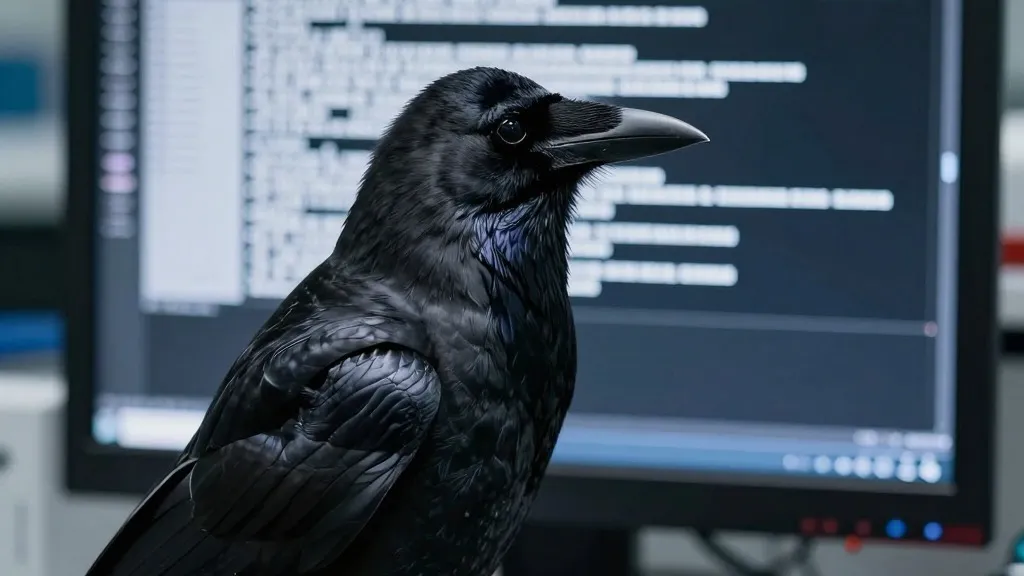
Carrion crows reach complex decisions using the same mathematical logic as primates, but they do so twice as fast.
For decades, the foundation of modern decision-making neuroscience has relied heavily on observations of monkey behavior. Specifically, scientists have studied how primates interpret a cloud of moving dots to determine direction. These experiments established a clear model where neurons in the neocortex gradually accumulate visual evidence. The firing rate of these cells rises until it hits a specific threshold, prompting the animal to commit to a final choice. This framework has become the standard for understanding how brains process ambiguous information over time.
However, this model left a significant gap in biological understanding because birds lack a neocortex. The avian brain is organized differently, which raised questions about how these creatures handle similar cognitive tasks. Andreas Nieder, a neurobiologist at the University of Tübingen, identified this structural difference as the central problem. He noted that the primary question was how a differently organized brain could encode decisions. This inquiry was crucial for understanding whether the standard primate model applies universally or is specific to mammals with a neocortex.
To address this, Nieder and colleague Philipp Schmidbauer conducted a controlled study using two hand-raised carrion crows. The setup was designed to be identical to the classic monkey experiments to ensure comparability. The birds faced a touch-sensitive monitor displaying white dots against a black background. A portion of these dots drifted in a specific direction, such as left, right, up, or down. The crows indicated their choice by pecking one of the targets next to the display. A correct selection resulted in a mealworm reward, providing a clear incentive for the birds to solve the task.
The researchers varied the difficulty of the task by adjusting the percentage of dots that moved coherently. At the easiest level, 81 percent of the dots moved in unison, making the direction obvious. At the most difficult level, only 3 percent moved together, making the signal barely distinguishable from random noise. The team also included a condition with zero percent coherence, where no correct answer existed. This range of difficulty allowed for a precise measurement of how the crows processed increasing amounts of uncertainty.
The results confirmed that crows employ the same accumulation logic as primates despite their distinct brain architecture. The birds did not use a different mechanism; instead, they utilized the same mathematical process to weigh evidence over time. Furthermore, the crows completed the task twice as quickly as their primate counterparts. This speed difference suggests that the avian brain may be more efficient at processing this type of visual decision-making, challenging the assumption that the primate brain is the most optimized model for such tasks.
This finding offers new context for understanding cognitive evolution. It demonstrates that complex decision-making is not exclusive to brains with a neocortex. Instead, it highlights that different neural structures can converge on similar functional solutions. For researchers and those interested in the mechanics of thought, this suggests that the underlying logic of decision-making may be more universal than previously believed. It opens the door to further exploration into how other non-mammalian species process information, potentially revealing new insights into the efficiency of biological computation.
Source: Ars Technica