Halley Comet Debris Creates Meteor Display Over Georgia
Astrophotographer Tim McCollum captured three Orionid meteors above Toccoa on October 21, showing debris from a comet located 3 billion miles away.
By Chioma Kim ·
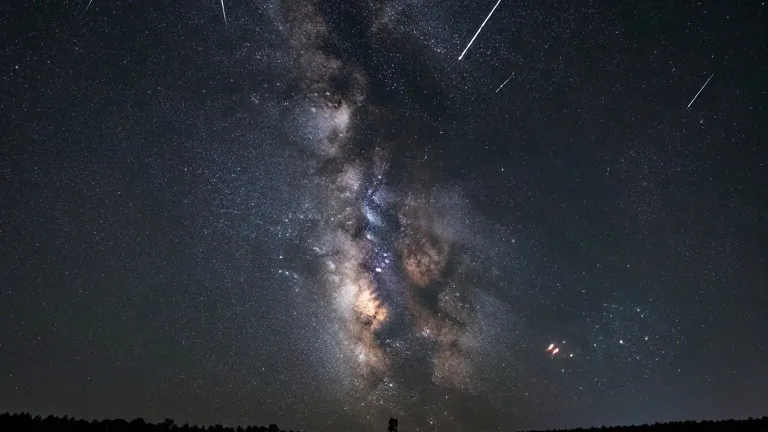
Tim McCollum recorded three bright Orionid meteors over Toccoa, Georgia, on October 21, capturing light trails from debris shed by Comet 1P/Halley. The comet currently sits more than 3 billion miles from Earth, yet the particles it released continue to burn up in the atmosphere as the annual shower builds toward peak activity.
McCollum took the photograph between 3 a.m. and 4 a.m. using a Canon EOS Ra camera paired with an RF 28-70 f2.0 lens. He utilized a star tracker to keep the equipment locked on the radiant point near Betelgeuse in Orion. The individual 30-second exposures were combined into a single composite image using PixInsight software.
The Orionids originate from material left behind by Halley's Comet as it traverses its orbit. Although the comet itself is distant, the stream of dust creates a visible meteor shower for Earth. McCollum noted that capturing these events requires patience and precise timing, as the meteors appear to radiate from a specific point in the sky.
The resulting image features more than just the meteor trails. The stars of Orion's Belt appear on the right side near the Orion Nebula, a nearby star-forming region. The Rosette Nebula, cataloged as Caldwell 49, is also visible within the dense starfield and dust lanes of the Milky Way's galactic plane, which runs diagonally across the frame. Numerous star clusters are scattered throughout the background.
The Orionid shower remains active until November 7, offering additional opportunities for skywatchers to observe meteors from Halley's Comet. Observers may also see a separate phenomenon during this period as Earth passes through debris streams from Comet 2P/Encke. This intersection can produce the Taurid meteor shower and the occasional Halloween Fireball.
McCollum's photo was taken earlier this week as the display intensified. The image illustrates the connection between distant cometary objects and the visible light in the autumn sky. The meteor activity is expected to continue through early November, with the potential for brighter fireballs from the Encke comet debris adding to the visual spectacle for those with clear skies.
Source: Space.com
More Business · Tech news · Unethical Practices · Report a business · Got a Story?