Households Build 72-Hour Reserves as UK Campaign Targets Supply Gaps
Officials urge citizens to stock three days of essentials, a shift driven by climate risks and security concerns.
By Christopher Richardson ·
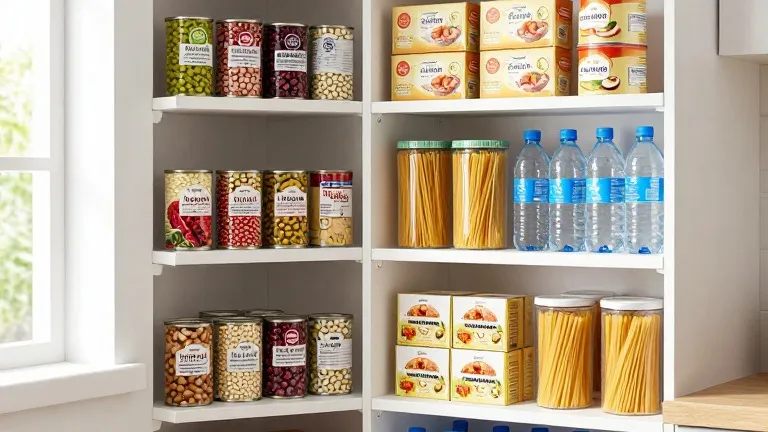
The UK government launched a campaign on Thursday instructing residents to maintain three days' worth of emergency supplies. The directive asks households to store dried foods, bottled water, medicines, and backup power sources. This move formalizes a trend that began several months ago, as ministers issued repeated warnings regarding state-sponsored threats and climate instability.
Lawrence Barratt of Hythe, Hampshire, began his preparations two weeks ago. He now adds tinned beans, soups, chilli con carne, noodles, and rice to his weekly grocery runs. He is also purchasing bottled water incrementally to sustain two people for three days. His storage area includes a first aid kit, a battery-powered FM radio, a torch, and a portable power bank. Barratt believes the power bank can charge phones, run a television, and operate a small fan heater.
Barratt cited online government advice and memories of the 2020 lockdown as primary motivators. He noted that the official Be Ready website made him realize he would be completely unprepared for any sudden disruption. His approach reflects a calculated effort to mitigate the shock of empty shelves, a phenomenon widely documented during the first pandemic restrictions.
Marco Camurri in Greenwich, London, adopted a more expansive strategy several months ago. He is stockpiling pasta, passata, stock cubes, tinned food, bottled water, medicines, and toilet paper. Camurri stated, "We remember Covid." His family maintains a fuel tank level above 50 percent, providing roughly 300 miles of driving range. They also store wood in their garden for boiling water and keep USB rechargeable flashlights, matches, and lighters ready for use.
Camurri’s family tracks the expiration dates of their supplies in a spreadsheet. They label these items as their "Doomsday Stash" and rotate them by eating the older goods before buying replacements. This method allows the household to maintain a reserve without incurring the cost of a full week's extra shopping. Their preparations began when reports linked El Niño weather patterns to potential supply chain disruptions.
Jack Davenport of North Shields, Tyne and Wear, also points to El Niño as a catalyst for his stockpiling efforts. He described the current threat environment as difficult to gauge, listing climate disasters, Russian shadow threats, artificial intelligence risks, and energy-driven interest rate rises. Davenport characterized the country's physical and technological infrastructure as creaking and outdated. He suggested the government aims to reduce long-term panic by framing these events as manageable possibilities.
Deirdre O'Sullivan of Leicester offers a contrasting view. She described the new guidance as daft, comparing it to 1970s nuclear attack advice that told citizens to hide under tables. O'Sullivan argued the recommendations are inadequate for a genuine emergency. She noted that any threat to drinking water should be identified more precisely. She also contended that an extreme food shortage would likely develop over a longer period than three days.
O'Sullivan likened the campaign to a policy devised to demonstrate governmental action, even if the policy is clearly totally useless. Her skepticism highlights a divide among residents, with some viewing the three-day target as a practical baseline and others seeing it as a symbolic gesture that fails to address the complexities of modern infrastructure vulnerabilities.
Source: The Guardian