Record tides flood Southern California coasts as three weather factors converge
High water levels in Orange and San Diego counties broke records Monday, with officials warning of more severe flooding through Thursday.
By Christopher Richardson ·
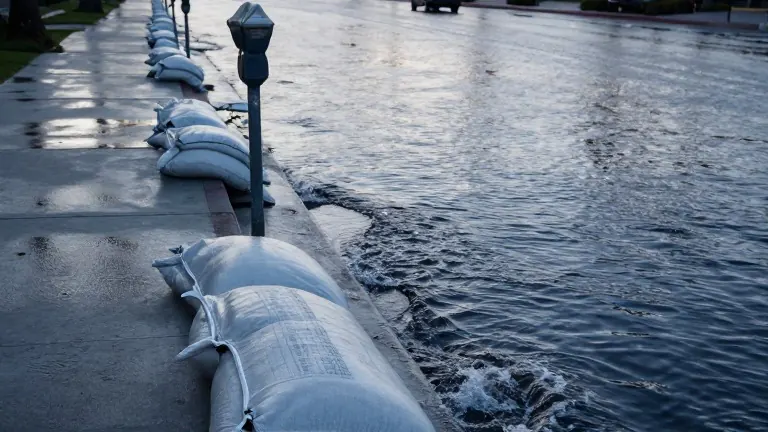
High tides flooded streets in Southern California on Monday as record-breaking water levels surged onto the coast.
The National Weather Service issued a coastal flood warning for Orange and San Diego counties that will remain in effect through Thursday afternoon. In Newport Beach, water from Newport Harbor pushed onto the streets of the Balboa Peninsula, flooding some businesses in the Balboa Fun Zone. Residents in Long Beach reported similar flooding along Bayshore Beach, Naples, and the Peninsula. Crews in Newport Beach worked to pump out knee-high water and reinforce sandbags along the harbor side of the peninsula. City officials reported no widespread damage despite the surge.
Georgia Rios, a spokesperson for the city of Newport Beach, attributed the limited damage to community preparation. She noted that approximately 25,000 sandbags were distributed over the weekend. Rios said, “We really saw the community come out. So I think a lot of the success of not having immense amount of flooding damage is due to residents taking part and grabbing sandbags for their homes.” Officials in both cities had urged residents to move vehicles to higher ground and protect property in the days leading up to the high tide.
The San Pedro tide gauge recorded a height of 8.02 feet on Monday morning, surpassing the previous record of 7.93 feet set in January 2005. In La Jolla, officials measured sea levels at 7.75 feet, close to the station record of 7.81 feet set in November 2015. Chandler Price, a meteorologist with the National Weather Service in San Diego, stated, “At this rate, considering we’re expecting higher tides tomorrow, we could break it.”
A convergence of three distinct threats has driven the current water levels. El Niño conditions are fueling an active eastern Pacific hurricane season, a marine heat wave is warming the ocean, and a rare astronomical alignment is amplifying tides. Scientists estimate that record-hot ocean temperatures are pushing seawater levels 1.25 to 1.8 feet higher than expected from lunar and solar movements alone. Surface temperatures at Scripps Pier in La Jolla reached 73 degrees on Thursday, well above the average of 66 for this time of year.
Total water levels in Los Angeles, Orange, and San Diego counties could exceed 8 feet above the baseline this week. The baseline is defined as the average daily lowest water level observed between 1983 and 2001. In Los Angeles, projected seawater levels at the harbor could reach 8.1 feet on Tuesday and 8 feet on Wednesday. Newport Beach officials said potential seawater levels could hit 8.5 feet on Tuesday at 9:50 a.m. and Wednesday at 10:28 a.m.
A coastal flood advisory was issued for Los Angeles, Ventura, Santa Barbara, and San Luis Obispo counties. The weather service warned that isolated damage to structures due to seawater inundation is possible in the most vulnerable areas. Long Beach’s breakwater protects the shore from western waves but allows southern waves to impact a narrow stretch of the peninsula that has suffered heavy damage this year.
Reinhard Flick, a researcher at the Scripps Institution of Oceanography at UC San Diego, explained that the current tides align with peaks in the 18.6-year lunar node tidal cycle and the 4.4-year lunar perigee tidal cycle. These cycles arise from small changes in the moon’s orbit. Scientists warn that if storms emerge during the king tide events around Thanksgiving, Christmas, and Martin Luther King Jr. Day, the coastal flooding risk will increase further.
Source: Los Angeles Times