Lunar Water Budget Caps Moon City at 10,000
A Harvard analysis concludes the moon's polar water reserves could support a town of 10,000 for centuries, not the million-person cities some executives envision.
By Chioma Kim ·
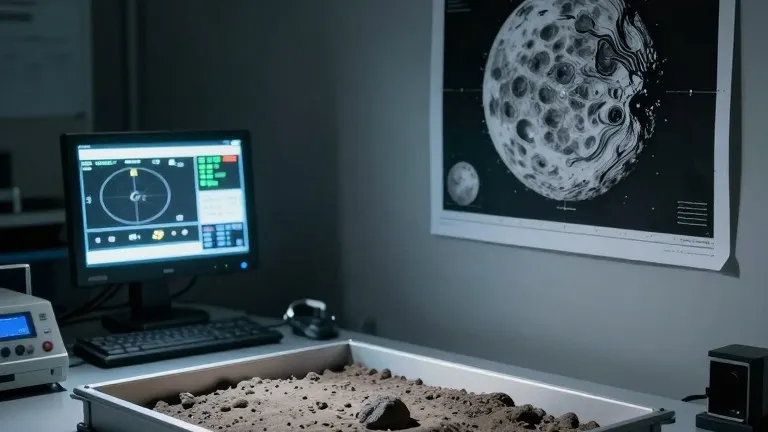
Plans for million-person lunar cities collide with a water budget that does not add up. An analysis by Martin Elvis of the Harvard Smithsonian Astrophysical Observatory and Jonathan McDowell of Durham University's Space Research Centre concludes that power generation is sufficient to sustain 1,000,000 residents on the moon, but water is not. Their paper, published in Frontiers in Space Technologies, evaluates claims about lunar settlement scale against available resources.
The calculations assume about one billion tonnes of water stored in permanently shadowed polar craters, a figure consistent with current estimates. Under that assumption, and with recycling at the 98 per cent rate achieved aboard the International Space Station, one million residents would exhaust the supply in roughly 100 years. A settlement of 10,000 people would remain viable for centuries on the same terms. Elvis compared the total volume to an aquarium the size of Central Park filled until the Statue of Liberty sits just underwater: "It's a small lake," he said, "and a small lake is not going to supply a big city for very long."
The paper responds to public commitments from technology executives. In February, SpaceX CEO Elon Musk wrote that the company had shifted its focus from Mars to building a "self-growing city on the moon" achievable in under 10 years, against more than 20 for Mars. Blue Origin CEO Jeff Bezos has said "millions of people" will live in space by 2045. McDowell addressed the gap between those ambitions and his findings: "If you want to cover the face of the moon with cities, like in the best science fiction, then you have to find a way to get the water there, because it's not there right now."
The water estimate itself may be overstated. Elvis said a billion tonnes is probably "20 or 30 times too big," and estimated that only one-third to one-half of the water present could be recovered. His figure for water that can be counted on is about one per cent of the original estimate, which would reduce the 100-year supply to one year. Gordon Osinski, a planetary geology professor at Western University in London, Ont., said satellite measurements carry uncertainties and wants the water confirmed on the ground. He described possible conditions resembling Arctic permafrost, with sub-millimetre ice crystals mixed into soil and difficult to extract.
McDowell said the constraints do not discourage exploration. "The truth is never negative," he said. "What's negative is to actually go and try and do something that isn't going to work."
His paper appears in Frontiers in Space Technologies.
Source: CBC News
More Business · World news · Unethical Practices · Report a business · Got a Story?